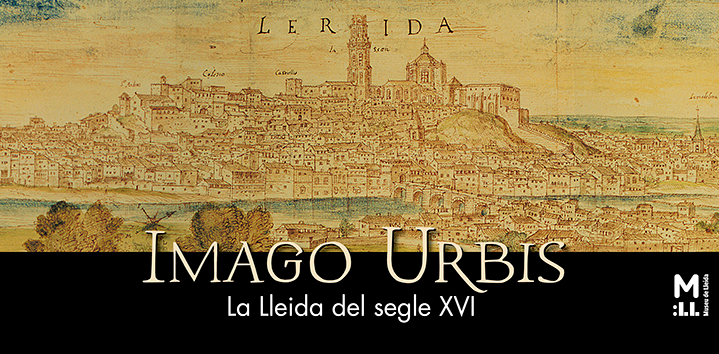
Imago Urbis. 16th-century Lleida
“This city is surrounded by stone walls and has good houses and a good region, the source of bread, wine, oil and a lot of fruit. The cathedral church is square, with three naves and a large cloister, one of the prettiest I’ve ever seen. From this spot there is a great and very lovely view, as the cathedral is located on top of a hill overlooking the fields of Lleida and banks of the Segre, surrounded by well-planted, well-tended fields and many houses with vegetable plots all around. The schools, although poor, both in buildings and revenue, supply the land of Catalonia great wealth in the doctrine of the sciences and the city of Lleida, ornament, as there are many doctors and students all around.”
Gaspar Barreiros, Chorographia de alguns lugares que stam em hum caminho, que fez Gaspar Barreiros ó anno de mdxxxxvi começando nacida de Badajoz em Castella, te à de Milam em Italia, con algunas outras obras, cuio catalogo vai scripto com os nomes dos dictos lugares, na folha seguinte, Coimbra, 1561
By the end of the 16th century’s first decades, Catalonia and Lleida had recovered from the serious political, social and economic crisis of the second half of the 15th century. This redress occurred as Europe’s political and economic axis was shifting toward the Atlantic, after the arrival in America, and as the Crown of Aragon was losing political and economic weight within the broad conglomerate of dominions controlled by the Spanish monarchy.
Lleida, a medium-sized city in the peninsular context, rediscovered a certain revival during the rest of the century. This prosperity came from the control of the rich agricultural hinterland. Its products, along with the new impetus of textile production, enabled a level of commercial activity which, while lacking the splendour of the past, kept Lleida connected not only to the adjacent reigns and territories, but also to Flanders or Italy. This progress would be truncated by the political crises of the 17th century.
Voussoir
1564
From a wall gateway in Lleida
Museu de Lleida
OBJECTS OF LUXURY, FOREIGN INFLUENCES
The lustreware technique —decorating pottery with a metallic glaze— was very popular in Manises from the late 14th century onwards and would later be employed in Reus and Barcelona as well. Thus, lustreware became an object of luxury and prestige, seen on the tables and shelves of all the leading families of the city and throughout the Crown.
Dish
Workshop in Manises
Late 15th century – early 16th century
Museum of Lleida. Repository of the Barcelona Design Museum
Dish
Workshop in Reus
1592
Museu de Lleida. Repository of the Barcelona Design Museum
High-quality productions associated with worship arrived from the Low Countries, diptychs or triptychs which may have been restricted to the private realm of prayer. The workshop of Dirk Bouts and his son Albrecht, in Leuven, was the source of numerous productions, such as the Ecce Homo —usually accompanied by the Mater Dolorosa—, which circulated around Europe in the form of copies like this one from the Augustinian convent in the district of Cappont.
Ecce Homo
Anonymous (copy of Dirk Bouts or Albrecht Bouts)
16th century
Museu de Lleida
THE CHURCH OF SANT JOAN, SCENE OF CHANGES
The church and market square played a striking role in Lleida’s civil and religious life from the time the temple was constructed in the 13th century. Right in the middle of the city, the square was the site of great celebrations. Thanks to the market held there, it became the neuralgic centre of economic activities, and nobles, knights, jurists and merchants established themselves in the neighbourhood. The Paeria, the centre of municipal power, was located there as well.
While in the 14th century the square was expanded and the church given a central retablo, over the course of the 16th and 17th centuries, the temple continued to grow more beautiful. In the early 16th century, the sculptor Damià Forment and his workshop executed work there.
Beheading of Saint John the Baptist
Compartment of the central altarpiece of the old church of Sant Joan in Lleida
Pere Garcia de Benavarri
1473-1482
Museu de Lleida. National Museum of Catalan Art repository
Epiphany
Damià Forment (attributed)
1525-1530
Museu de Lleida
The parish’s prestige might explain the tradition which links a sumptuous set of garments, safeguarded in this church, to the first Pope Borgia, Callixtus III.
AN EXCEPTIONAL OUTFIT IN THE MIDDLE OF THE CITY: THE GARMENTS NAMED “FROM POPE CALLIXTUS III”
According to entrenched tradition, these liturgical garments from the church of Sant Joan in Lleida were a gift from Pope Callixtus III. Alfonso de Borgia (1378-1458) studied and later instructed at the Studium Generale, as well as becoming a beneficiary of Sant Joan in 1408.
The liturgical garments include a cope, a chasuble, two dalmatics, two collars, two stoles, a maniple, a bag of corporals and a chalice veil.
No document corroborates the supposed legacy. The pieces’ physical and morphological characteristics seem to place them, chronologically, long after the pope’s life. Two phases must be distinguished: first, the pieces were fashioned from fabrics which, by their technical characteristics, with totally Renaissance patterns and designs, would belong to the 16th century; second, some embroidery and coats of arms with the heraldic symbol of the key would have been added in 1623.
Cope
Mid-late 16th century – early 17th century
Museu de Lleida
Chasuble and stole
Mid-late 16th century – early 17th century
Museu de Lleida
Dalmatic
Mid-late 16th century – early 17th century
Museu de Lleida
Collar, maniple, bag of corporals and chalice veil
Mid-late 16th century – early 17th century
Museu de Lleida
COPE HOOD
One of the most interesting elements of these liturgical garments is the hood which complements the cope. What draws the most attention, aside from the quality of the embroidery, is its iconography. The intimate depiction of the Holy Family and young Saint John with the gesture of silence seems to find its antecedent in a drawing by Michelangelo, known as the Madonna del Silenzio (around 1538-1540). Other painters, like Luis de Morales, El Greco, Lavinia Fontana or the Florentine Baccio Gorini, reproduced and reinterpreted this model.
Cope hood
Mid-late 16th century – early 17th century
Museu de Lleida
THE CITY IN DRAWINGS
Antoon van den Wijngaerde (1510 – 1571) was a Flemish artist commissioned by the king to draw a collection of views of the Peninsula’s most important cities.
The view of Lleida, executed from the current district of La Bordeta, shows a city which dominates a landscape of fields and spreads over the sides of the hill, articulated around the river. The top of the hill holds the main institutions of power: the Palace of the King and the Cathedral.
On the plain appear the churches of Sant Llorenç, Sant Martí, Sant Andreu, Sant Joan and Magdalena. They are the centres which articulate the parishes, which take shape as neighbourhoods.
The bridge leads to the walled suburb of Cappont, at the city’s southern entrance, with its own entrance gate where a great number of farmers gathered.
Multiple convents can also be distinguished: in the foreground, Sant Agustí, on the plain, Santa Clara, and, on a clearly differentiated hill, the former Templar commandery of Gardeny.
View of Lleida
Antoon van den Wijngaerde
1563
Österreichische Nationalbibliothek (Vienna)
Gardeny
Former Templar —later Hospitaller— commandery established in the land the Templars obtained by participating in the feudal conquest of Lleida in 1149. A structure with a walled perimeter and towers on the ends, in 1640 it became a military fortress and was completely remodelled.
Museu de Lleida (Jordi V. Pou)
Santa Maria Hospital
An example of 15th– and 16th-century Catalan civil Gothic architecture, it took in the ill and, especially, paupers and pilgrims on their way to Santiago or Rome and Jerusalem. The imposing Gothic sculpture of Saint Mary that overlooked the façade is conserved at the Museu de Lleida.
Museu de Lleida (Jordi V. Pou)
Mother of God of the former hospital of Santa Maria. Museu de Lleida
Church of Sant Llorenç
It was one of the first churches built after the conquest of 1149. Begun in Romanesque style in the late 12th and early 13th centuries, it was finished and expanded in Gothic style. The octagonal bell tower was built in the 15th century. Four Gothic stone altarpieces from the 14th-century Lleida School of sculpture are conserved inside.
Museu de Lleida (Jordi V. Pou)
Altarpiece of Sant Llorenç. Church of Sant Llorenç (Carles Aymerich)
Church of Sant Martí
It is another of the first churches built after the feudal conquest. The Romanesque building from the 13th century presents additions from the Gothic epoch. It was the parish of the university district of the Studium Generale. In the Reapers’ War, it was transformed into military barracks and, later, a municipal prison.
Museu de Lleida (Jordi V. Pou)
Seu Vella, Castle of La Suda and Bishop’s Palace
Three buildings stood together at the top: the Cathedral, or Seu Vella, a combination of Romanesque and Gothic art with classical 16th-century portals on the cloister, the Castle of La Suda, from the Andalusian era, later transformed into the King’s Castle, and the Bishop’s Palace, located across from the door of the Annunciation on the Seu Vella, or the Bishop’s door, and demolished in 1707.
Museu de Lleida (Jordi V. Pou)
Paeria, Bridge Gate, bridge and river
The bridge over the river Segre had been the main entrance to city’s walled enclosure since Roman times. Adjacent to the fortified entrance gate, the wall line was organised there; parallel to the river and just to the left of this door stands the Paeria building, the seat of municipal power. The Segre was crucial to agriculture and other activities, as was attested by the presence of the rafts which travelled down the Segre all the way to Tortosa.
Museu de Lleida (Jordi V. Pou)
Church of Sant Joan and market square
The Romanesque building, constructed after the conquest of 1149, was expanded and reformed on multiple occasions. The church was demolished in 1868 and replaced by the current one, begun in 1880. Located in the district where the city’s main market was held and inhabited by nobles, knights, jurists and merchants, it was the most important parish.
Lleida 6 October 1860. National Library of Spain (Charles Clifford)
1865 Drawing of the southern façade of the church of Sant Joan. Maltwood Art Museum and Gallery. University of Victoria, Canada. (Richard Roskell Bayne)
Floor plan of the old church of Sant Joan. Archaeological Archive of Lleida
Church of Santa Maria Magdalena
Built after the feudal conquest, the bell tower was added in the 15th century. The stone altarpiece of the main altar, the work of the sculptor Bartomeu de Robió, from around 1370, was overlooked by the image of Saint Mary Magdalene, now conserved at the Museu de Lleida. The church collapsed due to the explosion of the ammunitions store of the Castle of La Suda in 1812.
Floor plan of the old church of Santa Maria Magdalena. Archaeological Archive of Lleida
Maria Magdalena. Museu de Lleida
District of Cappont
In the suburb of Cappont, at the city’s southern entrance on the other side of the Segre, there lived a good number of peasants, who farmed the land, and a wide range of artisans. It seems to have been the site of certain textile manufacturing activities and the Augustinian and Trinitarian monasteries. The district was demolished in the Reapers’ War.
Museu de Lleida (Jordi V. Pou)
1550-1600. Preserved ruins from the old Cappont district, showing the change in economic direction through the proliferation of wine presses. Archaeological Archive of Lleida
1550-1600. Detail of a part of the dwellings and rooms, with the presence of presses for fermenting wine. Archaeological Archive of Lleida
HUMANISM IN LLEIDA
A new way of understanding the world was born in Italy in the 14th century and developed over the course of the 15th and 16th centuries. This new current was closely linked to humanism, an intellectual movement based on a renewed interest in classical culture and in man as a complete, harmonic individual. The trend spread everywhere thanks to the printing press.
Humanism came to Lleida in the 16th century thanks to the bishops Jaime Conchillos, Ferran de Loaces and Antoni Agustí, who stood out for their intellectual level and their work as leaders of the church of Lleida. Members of affluent or noble families, and educated at the best universities, they concerned themselves with four main issues: education, with the creation of new professorships at the Studium Generale of Lleida; the renewal and clarification of doctrine and customs, in consonance with the current of reform which culminated in the Council of Trent; interest in social work and charity, manifested in the improvement of the hospitals; and patronage of the arts.
Pharaoh Returns Sarah to Abraham
Philippe van der Cammen
1560-1570
Museu de Lleida
Uriah’s Farewell to Bathsheba
1530-1540
Museu de Lleida
THE CONVULSIVE 17TH CENTURY
At the turn of the century, with some 6,000 inhabitants, mostly farmers, Lleida was already the fourth most populated city in the Principality. The demographic increase, driven, in part, by the numerous French immigrants arriving since the previous century, levelled off around 1620. Not long before, the Moriscos had been expelled (1610), economic activity had begun to slow and social and political discontent had risen, coinciding with a very convulsive international context.
Europe was bleeding from armed confrontations, directly or indirectly associated with the struggle between France and the Spanish monarchy for political supremacy on the continent. The wars coincided, in addition, with new waves of plague and famine.
To sustain the military effort, the Spanish monarchy increased the fiscal and military pressure on its territories, which would lead to the outbreak of numerous revolts. Catalonia’s, begun in 1640, was crushed in 1652, which led to a profound crisis.
Lleida, shaken by all these crises, would be transformed into a small and irrelevant city; it would see many of its neighbourhoods begin to be demolished, including Magdalena and La Suda and all of Cappont, and would serve as the scene of new armed confrontations.
It would have to wait until the second half of the 18th century to see its partial recovery, the foundation of the physiognomy of the current city.
KORANIC BREVIARY (SERÒS) AND ALJAMIADO RELIGIOUS NARRATIVES (AITONA)
The breviary, written in Arabic, is a selection of surahs with instructions for prayer and worship, and the manuscript with religious narratives, a summary of pious texts written in Aljamia, a Romance language written in Arabic characters.
Morisco manuscripts were prohibited from the 1520s onward. Produced in secret, they were hidden inside homes, where they remained when their possessors abandoned them due to the expulsion of the Moriscos decreed by Philip III in 1609. Lleida’s Moriscos left on 2 June 1610. This expulsion culminated a process of social homogenisation through religion initiated by the Catholic Monarchs in 1492 with the expulsion of the Jews. In 1525, Emperor Charles I had ordered the baptism or expulsion of all Mudejars from the Crown of Aragon, and massive conversions were registered in Lleida during the years 1536-1546.
Morisco prayer book
Late 15th century – early 17th century
From Seròs, El Segrià
Museu de Lleida
Aljamiado religious narratives
Late 16th century – early 17th century
From Aitona, El Segrià
Museu de Lleida. Lleida Public Library repository
The Relief of Lleida
The painting depicts the relief of Lleida which occurred after months of siege, on 21 and 22 November 1646, when Philip IV’s troops, commanded by the Marquess of Leganés, entered the city victorious. Enric de Lorena, the Count of Harcourt, organised a siege of famine to reconquer Lleida and return it to the king of France. Governor Brito, in response, opted for rationing and incursions into enemy territory to rob supplies. In the painting, the herald who forms part of the procession presents, on his trumpet, the coat of arms of the Marquess of Leganés.
The Relief of Lleida
Alejandro Fernández
1964
Copy of the painting by Pieter Snayers (1646)
Lleida City Hall
The occupation of the other side of the river Segre began just after the city was conquered, in 1149. This new space, inhabited by the Andalusian population which was to remain in the city, would later be known as the district of Cappont. The area would be progressively transformed until 1642, when it began to be demolished as a result of the Reapers’ War.
Its final period, between 1625 and 1642, bore witness to remarkable artisan activity. To this period corresponds the identification of a workshop dedicated primarily to the manufacture of ex-votos and religious images made of wax. Among other tools, a matrix and a whole series of moulds, some included in this exhibition, were documented at the site.
Matrix and moulds for ex-votos and stamps
Workshop in Cappont
1625-1642
Archaeological Archive of Lleida